Or … now for something completely different …
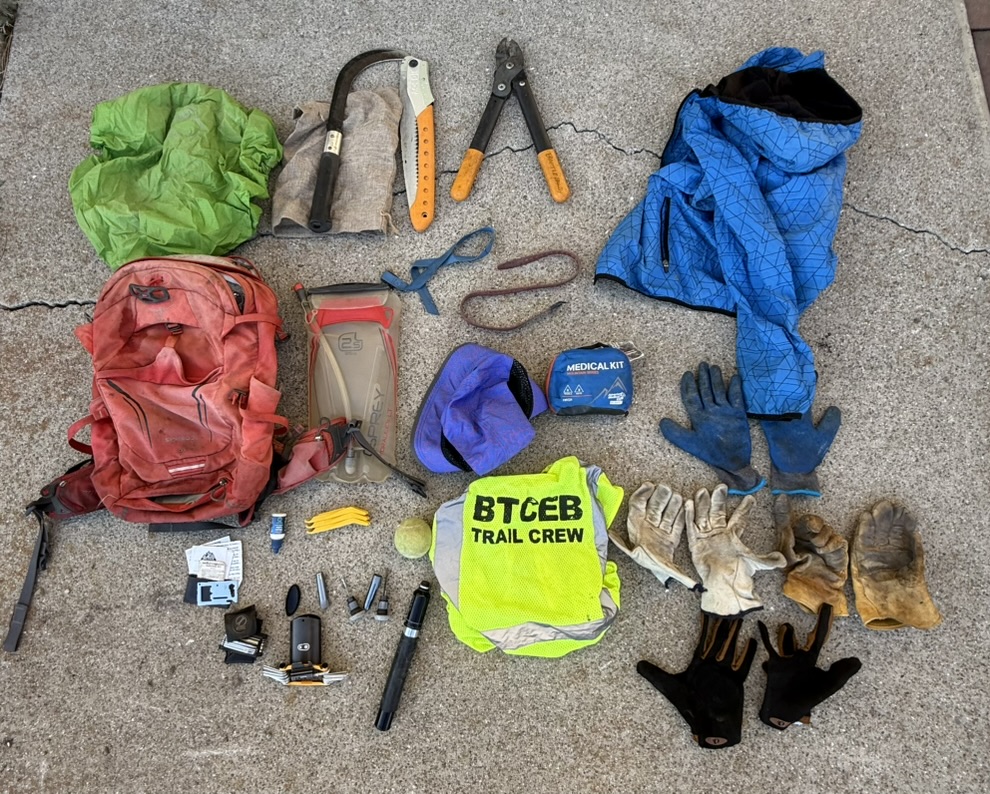
Here’s the second in what is probably going to be a series of “What’s In Your Pack?” articles. Okay, it’s not completely different than Rebecca’s pack contents but it’s got some noticeable differences and ventures where “normal” folks know better. (Normal is way overrated, by the way.) My pack still has the bits to fix your bike when it breaks, or when you break your bike, or to some extent you break yourself or you’re trying to prevent yourself from breaking. While not as in depth along those lines, it contains a fair amount of stuff for puttering around on the trail and dealing with a downed tree, cleaning up encroaching poison oak or other vegetation, and cleaning up sightlines.
Here we go, working our way down from the top left:
Pack cover: this stuffs into a purpose-built spot on the bottom of my pack. It can be used to keep your pack dry if things get wet or can be used as a seat to keep your bottom dry if you stop for some lunch or take a break during trail work.
Hand scythe: I also have some folding scythes, but this rigid scythe is my preference and holds up better. It works well on poison oak, grasses, and green or woody mustard, hemlock and the like.
Fiskers loppers: the right tool for cutting branches with diameters up to the size of your thumb or for slower but more precise poison oak work when slashing at it just doesn’t fit. These are lightweight but take a fair amount of abuse. And when you abuse them too much and a blade or something else breaks, Fisker has sent me replacement parts for free. Thanks again to Ben Chang and Kevin Smallman for turning me onto these loppers.
Burlap sack (size small): provides some mechanical protection from the scythe or lopper bad pocking through the pack, and also used to try to contain any urushiol (the oil from poison oak) and reduce its spread inside the pack. Luckily I’m not super sensitive but my luck will run out someday.
Silky Big Boy folding saw: limbs and trees come down and it’s nice to be able to address them right away to keep a trail open and people on the trail. It’s also nice to take that load off park staff (if you have park staff!) so they can focus on tougher problems. It’s a pricey saw but well worth it in my book for the quality, reliability, capability, compact size, and light weight.
Lightweight wind shell: the weather changes and sometimes you need more than you started out with. Having it ready all the time is nice.
Osprey Synchro 20 Pack: I’ve had a series of Camelbak and now Osprey packs, and I’ve slowly been selecting larger packs when I replace one that’s worn out. Tool-carrying capacity, a nicely sized water bladder, and general kitchen sink capacity are my current desires. For just a trail work-oriented day with more capacity to carry tools, I switch to a purpose-build Dakine Trailbuilder pack. The Synchro 20 has been the reliable daily driver for a few years and to the point that several of the buckles have failed. Osprey stands behind their gear and has quickly sent me replacement buckle parts sewn into a replacement strap. The fabric is sunbleached but it’s still holding up and the replacement buckles will probably keep this one going for a few more years. I was impressed by Osprey’s customer service and will likely keep using their stuff for quite a while.
2.5L bladder: As the Camelbak folks used to say, “Hydrate or Die.” 2.5L of dihydrogen monoxide can getcha through most days. There are a couple of open side pouches that will fit a water bottle for times when 2.5L won’t cut it and you can’t refill. One of mine typically has a tennis ball in it. (Keep reading if you don’t know what it’s for!)
A couple of straps: every so often you might need to lash something to your pack like a long handled tool or a cowskull or thigh bone just for funsies.
Bucket hat: I expect that UV radiation is gonna get me some skin cancer problems someday. Covering up when doing trail work isn’t a bad idea to put that off for a little longer.
First Aid Kit: sometimes you or somebody else gets sliced or diced and it can be helpful to do something about it.
Gloves, gloves, and some more gloves: they’re kind of a wear item, so when they start wearing through they’re okay for some tasks but not so much for others. Cheap bastards like me try to stretch them further than we ought to, so a new pair sometimes gets added but that holey worn pair sticks around so some more blood can be squeezed outta that turnip.
Safety vest: safety third! … and sometimes first and second! The vest is often worn although sometimes it’s just along for the ride. Sometimes I’ll put it out uphill as an indicator that something’s going on up ahead on the trail, but it seems like there’s a less than 50% chance that the message will be received as intended, though. It’s that that BTCEB logo for some more oh-so-effective advertising: “BTCE … B? Never heard of them ….”
Tire pump: sometimes there’s one on the bike and sometimes there isn’t. This one is usually buried in the pack and I forget that it’s even there. Tubeless tires with sealant have spoiled me … and now I can expect a flurry of flats!
Tennis ball: a tool to simulate water flow and see if it looks like your drain is likely to work or not. (Actually performance may vary.)
Tubeless tire plug kit: nice to have when you need it. All my bikes have a spare tube on them somewhere, so I don’t usually carry a tube in my pack.
Multitool, and maybe a second multitool: it’s good to have at least one with a chain tool, although you don’t need a chain tool as often as you did before quick links, but it can still get you out of a jam. New quick links would be a good item but they haven’t made it into my standard supply of staples yet.
Tire levers: good to have. They can probably work as a wedge to avoid a pinch when sawing a downed limb or tree. Sometimes there is an actual wedge in my pack, but not on this day.
Lube: never a bad idea to overcome undue friction …
Some weird credit card size survival tool: it’s always a good idea to review the crap you may have put in the pack and just keep carrying around but never use. This seemed like it might be a good idea at the time, and at least it does have a bottle opening built in.
BTCEB cards: always a good follow up to “Have you heard of BTCEB?” “Well, no, I haven’t …”
Items not shown that make it in there sometimes are some fig bars, gels, or chews to refuel. The Trail Boss breakdown tool when the work scope includes digging or a Henry Mitchell custom breakdown tool with a Rogue hoe or flat shovel head. The brushing tools get a break when the tread tools go in but the brushing tools are the daily drivers. A hand powered chainsaw is there every now and then. Sometimes a pair of compact binoculars or monocular will make it when I’m trying to spot the golden eagles.
Compared to Rebecca I don’t pay a lot of attention to weight per se. On my normal rides — okay, none of my rides! — I’m just not moving that fast and it ends up being more training weight, I suppose. I’m so used to it on my back that I kind of feel nekkid when I ride without a pack, but the extra mobility in that case is awesome!
Scott Bartlebaugh, Advocacy Director
P.S. And, for those who were wondering, my pack weighs a mere 14.4 pounds. It’s approaching the weight differential of a superlight bike, less the assist.