AKA what it takes to get just one trail built in the Bay Area …
TLDR (but it’s really worth the read if you care about new trails in the East Bay): We’re asking you to take two actions to keep this project moving forward. First, send an email to the EBRPD Board of Directors asking them to support further work on the Wildcat Flow Trail project and approve work on the environmental impact report. Second, sign on to the Wildcat Flow Trail petition to show your support for this project. Links are listed above. Below you’ll find a more in depth discussion of the project and its history. You can easily do this by going to WildcatFlowTrail.org. Below you’ll find a more in-depth discussion of the project and its history.
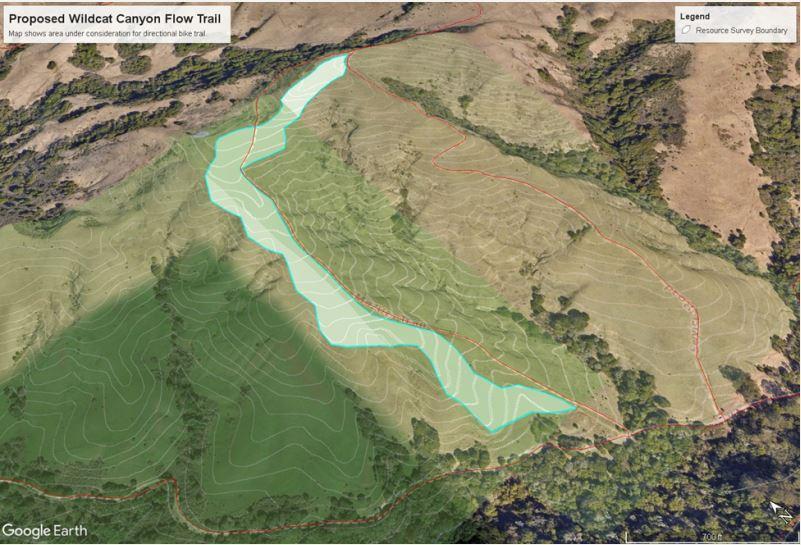
You’ve probably heard something about the Wildcat Flow Trail by now. To be clear, it does not yet exist. It’s just an idea … and a pretty good one. But good intentions only go so far in this world and the Wildcat Flow Trail (WFT) is still a ways off from becoming a reality. At about two miles in length with 600 feet of descent, it would be the first bike-only trail built in the East Bay. Bike advocates first proposed the trail in 2020 and now nearly five years later we are somewhere in the middle of a process dictated by a myriad of competing interests. In many respects, the saga of the WFT is representative of the state of trail access in our region, where riders are allowed to ride on most legacy ranch roads (except for EBMUD land!) but precluded from riding on most singletrack trails (what the Park District calls “narrow” trails). Unlike in regions like Tahoe or Santa Cruz, bike organizations in our region are rarely allowed to maintain trails and never allowed to build new ones.
The WFT would be built in Wildcat Canyon Regional Park, which is owned and managed by the East Bay Regional Park District (EBRPD). After considering the initial proposal from bike advocates in late 2020, the Park District began a methodical process to check to see if the project was feasible. The first step was to identify potential environmental concerns and possible mitigations. The proposed WFT passed this check, so EBRPD sought to gauge public support, which they found to be strong. EBRPD developed a preliminary trail design and held a public meeting on April 25, 2024, to discuss the trail in concept, and that’s where hope for this new trail sprang.
After clearing these hurdles, the District hired a CEQA (California Environmental Quality Assessment) consultant to start the state-required CEQA study.
The process followed by the WFT illustrates the long, costly path needed to get a new trail built in Park District land and, honestly, much of California. While frustrating to riders like us who have been waiting for years for better bike access, it’s important to acknowledge the constraints imposed on the district by the California Environmental Quality Assessment (CEQA), opponents to bikes, limited staff time, and the mission of the Park DIstrict with its strong emphasis on conservation.
The WFT has its origins and has been largely moved along by a group of teenage mountain bikers and their coaches from schools in Berkeley, El Cerrito, Albany and Kensington. For those riders, the 2,790-acre Wildcat Canyon park is close to their homes and it’s where they ride every week. And we’re talking about hundreds and hundreds of riders.
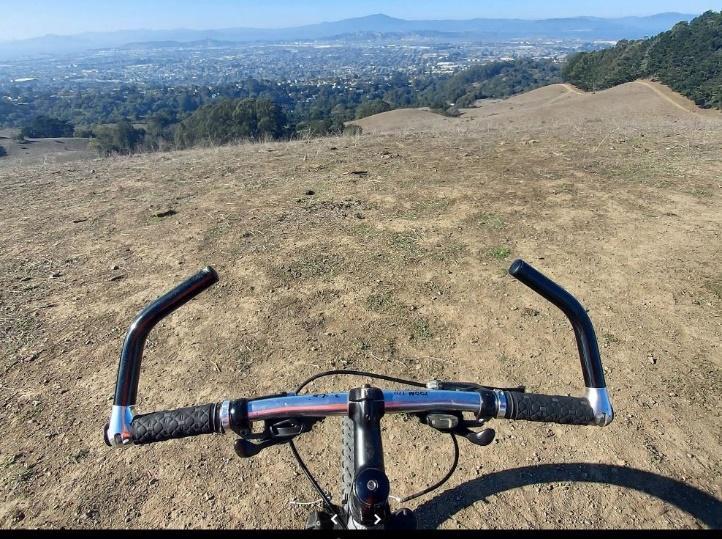
With its grass and weed-covered hills, the area around the proposed WFT resembles a cattle ranch more than a fully developed park and so it is reasonable to think that there is plenty of spare room for a new trail or two. After all, in recent years, off-road bike use has grown exponentially, yet the supply of legal trails has remained nearly flat.
In 2020 the idea of putting a flowing singletrack in the park began to get traction. A great spot seemed to be on the west-facing hillside of the park, where the existing Mezue fire road makes its way down the steep slope toward the bottom of the valley. Due to its steep and eroded surface, the dirt road is no joy to ride up or down. Less steep and meandering trails like the WFT are more fun to ride on, and bike speeds are slower, which makes them safer both for cyclists and for hikers. Such trails are built all across North America and Europe and are hugely popular.
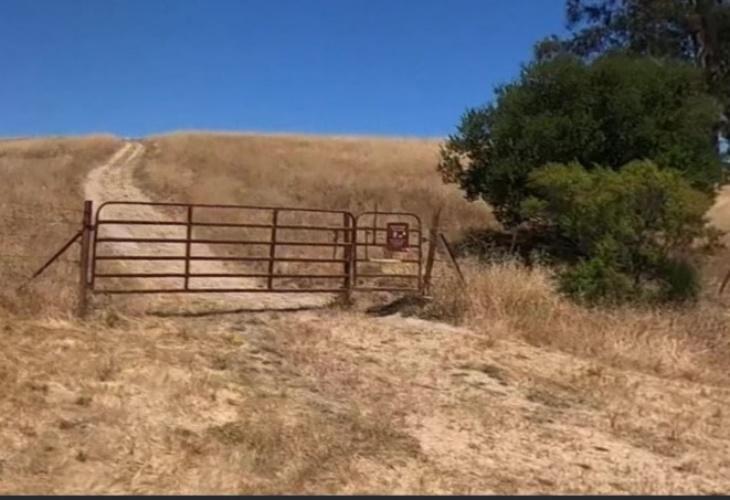
Wildcat Canyon Regional Park is contiguous with its older sibling Tilden Regional Park to the south but sees far less visitation than Tilden. Whereas Tilden Park is both an open space park and a traditional urban park — with a variety of amenities and attractions, from a swimming pond to a half-scale steam railroad — Wildcat Canyon resembles more the private ranch it once was. Encompassing the Wildcat Creek watershed, the park runs from ridge top to ridge top, affording some nice views of the San Francisco Bay to the west and Mount Diablo and the Sacramento-San Joaquin Delta to the east. The park is crisscrossed by 25 miles of wide, dusty ranch roads and is grazed by cattle under a lease managed by the Park District. So it sounds like a blank slate for trail building, right?
EBRPD actually has a staff of professional trail designers and managers who could probably do more if the process to get new trails in the ground wasn’t facing constant pushback and legal challenges. In fact, the Park District’s small team of trail experts spend a great deal of time getting multi-use paved trails built in urbanized, highly constrained spaces. It takes years and millions of dollars to get just a mile of paved shoreline trail installed, but the result is that the more remote parts of the parks get less attention.
Off-road bicycle use in the East Bay has long faced vocal opposition from a small group within the local chapters of the Sierra Club, Native Plant Society and the local chapter of the National Audubon Society — despite the fact that this opposition strays far from the national missions of those organizations. Several years of engagement by the mountain bike community with the local SF Bay Sierra Club chapter has resulted in a moderation of their position and, most recently, in a letter to EBRPD supporting further study of the WFT. In case this isn’t obvious: this is no small feat!
Legal challenges under CEQA have become a bludgeon wielded by opposition groups to hinder the efforts of public agencies to approve and build projects, be that trails or affordable housing. In fact, this mechanism has been used so often to stop infill housing development that major changes to the law were recently enacted by our state legislature (for a deep dive, search on YIMBY – Yes In My Backyard).
Despite the negativity of a few, the EBRPD board has approved several hundred thousand dollars of funding for a CEQA study related to further work on the trail. The first phase of the CEQA environmental impact report was to be completed by the end of 2024, but it has been delayed. Now, with some changes in the membership of the EBRPD board of directors, staff will review the project status and request confirmation to proceed with the environmental impact report work at their August 5 board meeting. We need our biking community to express their support via an email to the Board and by signing the petition that can be found at WildcatFlowTrail.org.
One argument for new trails is that they take pressure off the other trails and therefore reduce potential conflict between various kinds of trail users. There is truth to this since hikers tend to want to pick a more direct route between points on a landscape even if it means marching straight up a rutted fire road, whereas bike riders usually don’t mind a more involved path if it means that it’s less steep overall. For many bike riders it’s the journey that matters the most, not just the destination.
You can find past reports on the Wildcat Flow Trail project in these previous BTCEB posts:
April 2024 Wildcat Flow Trail Public Meeting Report
Wildcat Flow Trail Stewardship Study Published
January 2022 Advocacy In Action
Tom Gandesbery, Trails Director
Update from August 5 EBRPD board meeting: The Wildcat Flow Trail (or, as EBRPD referred to it, the Wildcat Bike Trail) Notice of Preparation passed by a vote of 5 to 2, with the two opposing votes placed by Olivia Sanwong and Lynda Deschambault. Sanwong opposed to make a point on some procedural items but was generally supportive otherwise and expected that it would pass. Deschambault was hung up on a lack of adequate detail on trail user numbers and balancing the missions of conservation with recreation, but is not against MTB access.
For the supporting votes: Elizabeth Echols provided solid support, beyond her normal support, and Colin Coffey stepped up his MTB support. Dennis Waespi noted that the environmental impact report will bring more information and supported the study. Luana España said that Echols made her comments so eloquently, explained that this isn’t a final design for this trail, and supported additional outreach. John Mercurio noted the huge enthusiasm at this meeting, the biggest in his three years on the board, repeated the message that having a bike-only trail increases safety, and noted all of the volunteer groups that were represented and that the MTB community turns out volunteers.
This was a 5 1/2-hour meeting that started after a 30-minute delay and had good turnout by Wildcat youth, with two particularly strong youth comments by Aria and Harper from the Wildcat Youth Advocates during the second Zoom commenter section. Thanks to everyone who contacted the EBRPD board in advance of this meeting to express their support and to everyone who showed up at the board meeting to comment on behalf of the project.
Thanks to Elizabeth Echols, Colin Coffey, Dennis Waespi, Luana España and John Mercurio for their support of the Wildcat Flow Trail. Feel free to reach out to them to thank them for their support. And if you live in Ward 2 (represented by Lynda Deschambault) or Ward 5 (represented by Olivia Sanwong), please consider reaching out to them to express your support for the Wildcat Flow Trail and hope that they will vote for access for MTB riders at future meetings. If you aren’t sure which ward you live in, check out the EBRPD ward map. Here’s a list of the EBRPD board members, and their email addresses are available if you click on each name in turn.